KNOWLEDGE MANAGEMENT · TRAINING & ADVISORY

Keep the expertise Put it to work.

Help your people learn to capture, retain and transfer your experts’ knowledge. Dr. Dan Asher combines practical training with organizational knowledge management (KM) assessments and technology reviews to build these capabilities within your organization.

For leaders in business, human resources, knowledge management, learning and technology.

THE “ONION MODEL” FOUR LAYERS OF KNOWLEDGE
01 02 03 SHOWME 01 WHAT02 HOW03 WHY

Make the thinking
behind the action visible.

Expertise in action

Can you show me?

At the core is ability that an expert can demonstrate but cannot fully put into words. Others develop this ability through observation, guided practice and feedback.

Ways to explore this layerDemonstration, observation & guided practice

The “Onion Model” · From facts to ability KNOWLEDGE → CAPABILITY
100+ experts involved in knowledge extraction projects
Peer-reviewed publications Research into tacit knowledge and expert practice
KMGN global course Co-creator and session leader · 2024

COURSES & WORKSHOPS

Build your organization’s
knowledge capabilities.

Equip your people to manage knowledge themselves. Dan’s programs combine concepts and practical tools with work on your organization’s own challenges, with expert knowledge retention at their core.

For managers, HR and learning teams, knowledge professionals, experts and the employees who will lead knowledge practices across your organization.

Explore a program to see what your team can learn.

Experts often know more than they can explain in a general interview. This course trains employees to elicit tacit knowledge, explore real situations and organize the findings into clear knowledge items. Participants select an expert and a real knowledge challenge, then apply the methods between sessions. Throughout the course, participants work toward a completed knowledge retention project, developing internal expertise while creating a resource their organization can use.

For Knowledge professionals, HR and learning teams, and employees selected to lead expert knowledge projects.

Plan this course for your team

Learning focus

Recognize different layers of explicit and tacit knowledge.
Use expert interviews, real cases and targeted questions.
Extract reasoning, practical know-how and decision criteria.
Structure findings into connected knowledge items that others can learn from.
Apply the methods to a real expert knowledge retention project.

Applied work An expert knowledge project developed during the course.

Knowing how to perform a task does not automatically make that knowledge easy to share. Experts may skip steps that feel obvious, rely on professional shorthand or struggle to explain their judgment. This program helps experts recognize what they take for granted and make their knowledge accessible to colleagues. It also addresses the knowledge gaps that persist after a handover, helping teams connect learning from experts with mentoring, role transitions and practical learning resources.

For Experts, mentors, managers and teams responsible for succession and knowledge transfer.

Plan this program for your experts

Learning focus

Recognize what an expert takes for granted.
Surface tacit knowledge through questions and examples.
Explain professional reasoning in language others can understand and apply.
Choose suitable written, visual and digital learning resources.
Build a knowledge base that supports handover and mentoring.

Applied work A structured transfer plan for a real role or area of expertise.

This course gives managers a practical understanding of knowledge management and how it supports organizational performance. Participants examine how relevant knowledge is organized, how it reaches employees and how experience becomes a resource for future work. Practical tools help managers retain knowledge, learn from experts, capture project insights and share knowledge through everyday work routines. Exercises connect the material with each manager’s own organizational challenge, making the learning relevant to decisions they already need to make.

For Business leaders, department and team managers, and HR managers.

Develop your managers’ KM capabilities

Learning focus

Connect knowledge needs with business priorities.
Organize and maintain a relevant knowledge core.
Capture insights and useful practices from projects and events.
Retain knowledge and strengthen learning from experts.
Integrate knowledge sharing into management routines.

Applied work Practical actions for a knowledge challenge in the manager’s team.

Knowledge champions need a broad view of the field and practical tools they can use with their colleagues. This program introduces knowledge management and develops the skills to assess current practices, map critical knowledge and build a knowledge core: an organized body of knowledge that supports the work. Participants learn how to organize knowledge using a taxonomy, capture and retain knowledge, and encourage learning from experts. The aim is to develop people who can turn knowledge management into an ongoing organizational practice.

For Designated knowledge champions, knowledge coordinators and emerging KM leaders.

Build your network of knowledge champions

Learning focus

Understand the principles and scope of knowledge management.
Use diagnostic tools and a knowledge matrix.
Create a knowledge core with a practical taxonomy.
Apply tools for knowledge capture and retention.
Encourage sharing and learning from experts.

Applied work A knowledge map and initial plan for the champion’s area of responsibility.

Useful knowledge emerges while people are doing the work. This training explores how to capture it through routines that teams already use: onboarding, mentoring, debriefs and after-action reviews, project learning and employee departures. Participants learn to ask questions that reveal practical insights and tacit knowledge, structure what they find and make it available to the next person who needs it. The program connects individual experience with a knowledge base that can keep developing over time.

For HR and learning teams, project leaders, mentors, managers and knowledge champions.

Bring knowledge capture into daily work

Learning focus

Onboarding: identify what a new employee needs to learn.
Mentoring: capture the reasoning behind expert guidance.
Debriefs: turn experience into lessons through structured reflection.
Projects: capture insights while they are still fresh.
Employee departure: structure handovers and capture knowledge before someone leaves.

Applied work A knowledge capture routine for a relevant work process or employee transition.

Introducing a new system or approach changes how people work. This training examines the emotional responses that change can produce and the connection between human psychology and technology adoption. It introduces models and methods for embedding change, with a focus on the people who will use the new system or adopt the new practice. For a knowledge management initiative, this means considering adoption alongside the technology and the process from the outset.

For Managers, HR professionals, KM teams and IT leaders introducing new systems or work practices.

Support adoption of your KM initiative

Learning focus

Understand emotional responses to organizational change.
Connect psychology with technology adoption.
Explore models and methods for embedding change.
Apply the learning to a new system, concept or work practice.

Applied work An approach to supporting adoption in your own change initiative.

DESIGNED AROUND YOUR ORGANIZATION

Learn the methods.
Apply them to your work.

Programs can be tailored to your needs and delivered in person, online or in a hybrid format. We start with the capabilities your people need to develop and use examples relevant to your organization.

Discuss a training program

AT THE HEART OF OUR WORK · EXPERTS’ KNOWLEDGE

Retain what makes
your experts experts.

Experience lives in decisions, patterns and small details. We help you capture that knowledge and teach your people how to learn from experts and develop organizational capability.

EK

Expert knowledge
retention & extraction

Protect critical know-how when people retire, change roles or move on. Capture expertise during everyday work to strengthen continuity and help the next generation develop.

Explore the extraction course
01

Find the knowledge that matters

Map critical expertise, identify where knowledge is concentrated and prioritize what needs to be retained.

02

Capture the reasoning

Use expert interviews, real cases, observation and relevant media to elicit know-how, decision criteria and context.

03

Create knowledge people can use

Develop decision guides, learning resources and structured knowledge, then validate them with the expert and intended users.

Typical outputs
Expert knowledge maps Decision guides Learning resources Structured knowledge assets

ASSESSMENT & ADVISORY

Understand where you are.
Know what to develop next.

Alongside training, we assess your current knowledge management practices and systems, then identify the skills, processes and technology your organization needs to develop.

01 / CURRENT STATE

Organizational KM assessment

Assess how knowledge is created, organized, shared and used today. Identify gaps in critical expertise, knowledge flows and work practices, then clarify priorities for development.

Knowledge needs and critical expertise
Current practices and knowledge gaps
Priorities for training and organizational improvement
Assess your current situation
02 / SYSTEMS & REQUIREMENTS

KM technology assessment

Assess how well your existing knowledge environment supports the work people need to do. Translate knowledge needs into requirements for your IT team and technology providers.

Existing platforms and selection criteria
AI readiness
KM technology specifications and integration requirements
Review your knowledge systems
03 / STRATEGY & PRACTICE

KM strategy & implementation

Translate the assessment findings into a practical roadmap. Define knowledge roles, work routines and priorities that fit your organization, then identify the capabilities your people need to put the plan into practice.

Strategy and implementation roadmap
Governance and knowledge champions
Transfer, learning and retention in work routines
Discuss your next steps
04 / AI KNOWLEDGE FOUNDATIONS

Knowledge for generative AI

Structure expert knowledge and organizational content to give AI agents relevant reasoning, context and source material.

Content quality and knowledge structuring
Expert validation and source traceability
Knowledge foundations for AI agents
Discuss AI knowledge readiness


YOUR PRIORITIES

Different responsibilities.
A shared knowledge challenge.

BUSINESS LEADERS

Keep critical capability
inside the organization.

Understand where expertise is concentrated, what is at risk and which knowledge will make the greatest difference to the business.

Prioritize expertise linked to critical work.
Develop managers’ knowledge management capabilities.
Connect training and assessment with operational needs.
Talk through your priorities

OUR APPROACH

From expertise
to everyday use.

Start with the business need. Work closely with the people who hold the knowledge. Make sure the result supports the decisions and tasks it is intended for.

01

Focus

Define the business challenge, identify critical knowledge and agree on who will use it.

02

Extract

Explore real situations and uncover the reasoning behind expert practice.

03

Structure

Organize the findings into clear, connected knowledge resources and validate them with the expert.

04

Embed

Integrate the knowledge into work, learning and the appropriate technology.

RESEARCH THAT INFORMS THE PRACTICE

The “Onion Model” of tacit knowledge

Co-authored by Dan Asher and Micha Popper, the model explores the connected layers of tacit knowledge and the methods suited to eliciting them. It provides a conceptual foundation for looking beneath an expert’s first explanation.

Read the published research (opens in a new tab)
THE LEARNING
ORGANIZATION
2019
Dr. Dan Asher
Dr. Dan Asher The Tacit Dimension · Knowledge Management
“There are things your experts know that they will never be able to tell you.” Dr. Dan Asher

RESEARCHER · PRACTITIONER · EDUCATOR

MEET DR. DAN ASHER

The person behind
the practice.

Dan combines research into tacit knowledge, years of organizational leadership and hands-on work with experts across professions.

Before leading his consulting practice, Dan served as a knowledge management and learning innovation leader in a government organization. His experience spans management, organizational learning and the interpersonal skills needed to understand people’s work and help them share what they know.

His doctoral research at the University of Haifa focused on tacit knowledge in professions that rely on interpersonal interaction. He explored how expert knowledge can be elicited and structured to address organizational knowledge loss. His peer-reviewed publications examine the layers of tacit knowledge and ways to elicit expertise from interpersonal interactions.

Dan has worked with more than 100 experts on knowledge extraction projects. He describes himself as a “pracademic”: someone who connects theory with organizational practice. His work combines curiosity about people and technology with a practical interest in how knowledge supports real decisions.

Teaching your people to do the work

Dan co-created and led sessions in the Knowledge Management Global Network’s 2024 online course, “Leveraging the Value Creation of Tacit Knowledge.” His courses connect methods with participants’ actual organizational challenges. In the extraction course, employees work with an expert and develop a knowledge retention project as they learn. His advisory work complements this training with organizational assessments and KM technology requirements.

At Israel Aerospace Industries, an expert knowledge project developed into a broader engineering knowledge initiative, connecting a structured knowledge core with a generative AI agent.

01 Understand the work

Begin with the realities of your organization.

02 Develop your people

Build the skills to capture and share knowledge.

03 Connect the pieces

Align people, knowledge practices and technology.

RESEARCH · RECOGNITION · INTERNATIONAL EXPERIENCE

A practice grounded in research.
Experience shared internationally.

PUBLISHED RESEARCH

Peer-reviewed publications on tacit knowledge

Dan’s research explores how expert knowledge can be understood, elicited and put to use. These articles connect the conceptual model with methods for uncovering expertise.

INTERNATIONAL TRAINING · KMGN 2024

Co-creating and teaching a global KM course

Dan was a co-creator and session leader for the Knowledge Management Global Network’s online course, “Leveraging the Value Creation of Tacit Knowledge.” He developed the course with Moria Levy, Fisher Yu and Vincent Ribiere.

Interviewing to elicit tacit knowledge
Learning from experts and facilitating knowledge transfer
Capturing tacit knowledge in interpersonal interactions

The program brought his methods to an international KM learning environment.

PROFESSIONAL RECOGNITION · 2026

MIKE Award Expert Panelist

Recognized as a 2026 Southeast Asia & National MIKE Award Expert Panelist. The role involves contributing professional knowledge and judgment to the evaluation of organizations’ knowledge management and innovation practices.

Issued by IKI-SEA, Bangkok University · September 18, 2026

View the recognition (opens in a new tab)
UPCOMING CONFERENCE · NOVEMBER 2026

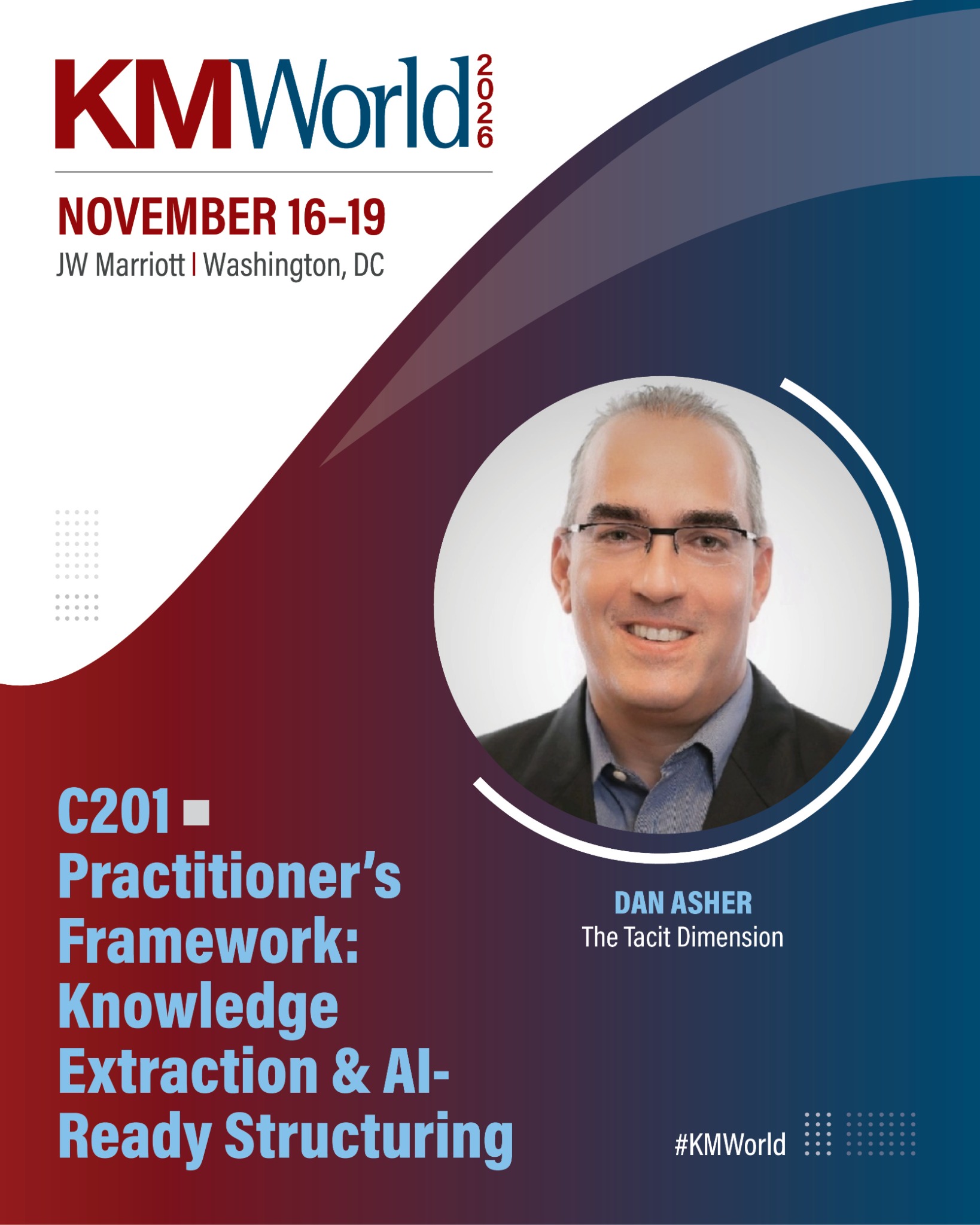
Speaking at KMWorld 2026

Practitioner’s Framework: Knowledge Extraction & AI-Ready Structuring

Dan will share his approach to extracting expert knowledge and structuring it for use with generative AI.

Session C201 · November 18, 2026
10:45–11:30 a.m. · Washington, DC

View the official speaker page (opens in a new tab)

A FEW COMMON QUESTIONS

Before we start.

Retirement is one reason to capture expert knowledge. The same work can support role changes, succession, onboarding, everyday learning and the development of knowledge resources for AI. Capturing expertise while it is still in use gives others time to learn from it and test it in practice.

That is one of the main reasons to use a structured extraction process. We explore real cases, decisions, observations and examples to uncover knowledge that may not emerge in a general interview or in response to a request to write a manual.

Yes. We assess the current environment and define how knowledge should be organized, found, shared and maintained. Where appropriate, this includes requirements for SharePoint and Microsoft 365 and coordination with your IT team or technology provider.

Expert knowledge can add reasoning, exceptions and context that are absent from existing documents. We help structure and validate those knowledge assets, document their sources and connect them with the intended AI use case. We also define how to validate and maintain the knowledge and review the resulting AI outputs.

Yes. Practical courses and workshops help your employees develop the skills to elicit, structure and transfer knowledge. Programs can be built around a real expert knowledge project, so participants create useful resources for their organization as they learn.

LET’S START WITH YOUR CHALLENGE

What should your people
be able to do next?

Tell Dan about your people, your knowledge challenge and the capabilities you want to develop. Start with a course or workshop, an assessment of your KM practices, or a review of your knowledge systems.

Discuss training or assessment [email protected] +972 50 349 0606

Use the contact form to send your message directly to Dan.

Privacy on this website

This website does not use advertising or analytics tools and does not collect information through an online form. Contact links open your email or phone app.

If you email us, the details you choose to share will be used to respond to your inquiry. For questions about your information, contact [email protected].

The website hosting provider may process technical information needed to deliver and secure the website. External links lead to websites with their own privacy practices.

1 / 2

Image viewer